
Before we dive in, why not take a quick peek at my portfolio: https://priyalraj.com
📋 TL;DR: What You’ll Learn Here
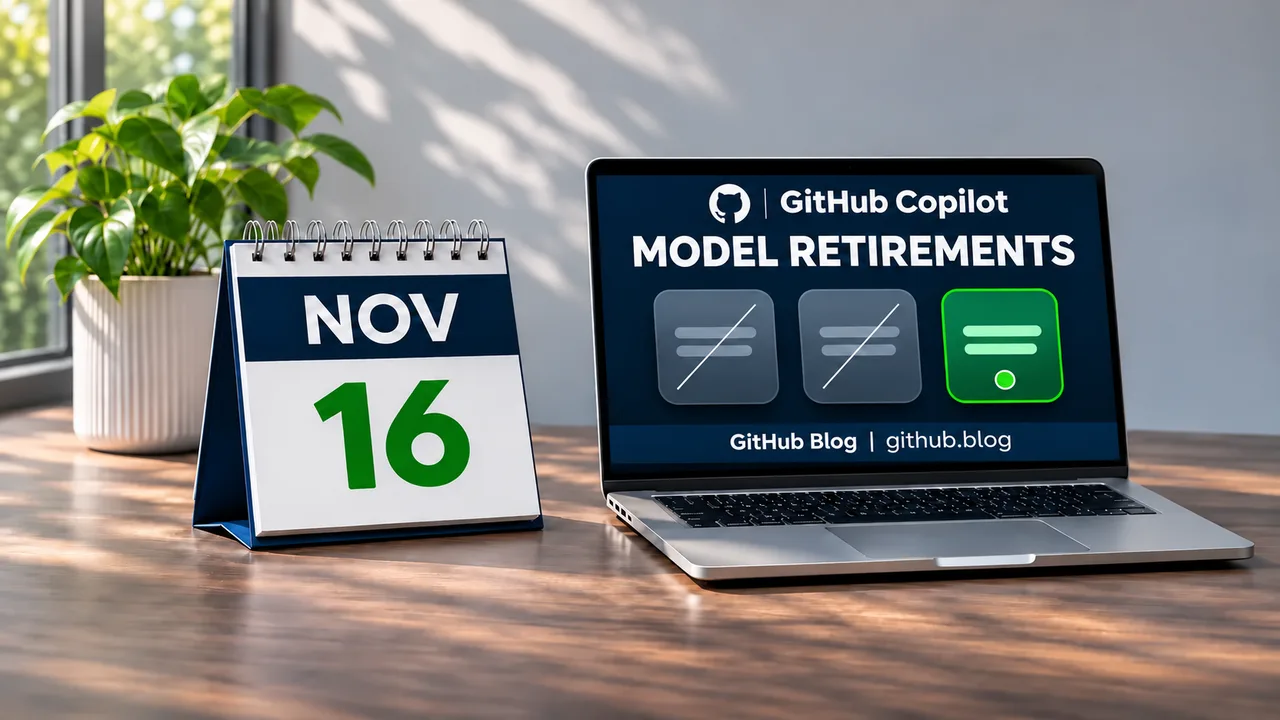
November 16 deadline: which Copilot models GitHub plans to retire.
Annual-plan exception: why Claude Opus 4.8 needs account-specific checks.
Replacement readiness: separate team access from useful coding results.
Practical rollout: test representative tasks before changing shared guidance.
📰 What GitHub Announced
GitHub Blog’s October 15 announcement schedules these Copilot model retirements for November 16, 2026:
| Affected model | GitHub’s suggested replacement |
|---|---|
| Claude Opus 4.8 | Claude Opus 5.5 |
| Claude Opus 5 | Claude Opus 5.5 |
| GPT-5.6 Terra | GPT-6.1 Sol or GPT-6 Luna |
Scope includes Copilot Chat, inline edits, ask & agent modes, plus code completions.
Exception: individual Copilot subscribers on annual plans retain Claude Opus 4.8. Don’t apply that exception to every account or model.
For Business & Enterprise, default model enablement enables suggested alternatives unless admins disabled global default or specific model. Otherwise, review model policies. Enabled options appear in supported Copilot Chat selectors. GitHub says deprecated models need no manual removal.
That’s announced change. Remaining sections describe my proposed preparation process, not measured results from replacement models. No speed, quality, or cost winner claimed here.
🧭 Start With Actual Usage
My first question: where does affected model appear in daily work?
Check editor habits, onboarding notes, saved prompts, internal tutorials, & integration settings your team owns. Include screenshots embedded in docs. Old screenshot can keep teaching wrong selection long after text gets fixed.
Think of changing workshop tool. Ordering replacement helps; finding every bench using old attachment finishes preparation. Model picker deserves same attention as workflow built around it.
Make short inventory with owner, task, current model, candidate replacement, & verification status. Use existing issue tracker. No separate migration dashboard needed for three people.
For freelancers, separate personal account from client-managed account. Access visible in personal editor proves little about client’s org policy. Put each account context beside its test result.
Avoid turning inventory into collection of chat transcripts. Record task category & outcome; retain sensitive project material only through approved team process.
🗓️ Give Deadline Named Owners
I’d schedule three checkpoints: inventory complete, replacement available, representative tasks checked. Assign person to each. Calendar reminder without owner becomes everybody’s problem during client delivery.
Keep internal target ahead of cutoff. Leave room for admin availability, blocked access, & task retesting. Choose dates fitting team’s workload rather than copying universal rollout calendar.
Small team can finish with one shared ticket. Larger org can split by team while keeping same acceptance conditions. Different ticket count shouldn’t produce different meanings of ready.
My tip: Define completion before testing: affected users can access approved replacement, important tasks remain workable, & shared instructions stop recommending retired option.
Buying subscription, seeing model name, or receiving admin confirmation answers only part of that definition.
🔑 Check Access Before Comparing Answers
For team rollout, separate policy owner from developer checking results. Ask owner to confirm intended model policy; ask developer to open actual supported experience & verify selection.
Record account context, editor, date, & observed option. If access differs between colleagues, capture difference before guessing cause. Subscription context, policy, or client setup deserves evidence.
Don’t paste guessed API model identifiers into application config based on Copilot display names. This announcement concerns Copilot access. Separate provider API migration needs its own primary docs & tests.
Likewise, keep replacement evaluation narrow. Admin enabling model doesn’t establish suitability for payment code, auth changes, or unfamiliar repository. Those decisions belong with normal engineering review.
If access remains unresolved, ticket stays open with named owner & next check. Avoid labelling untested alternative ready because retirement deadline feels uncomfortable.
🧪 Build Small Representative Task Set
I’d choose tasks from real development patterns, using non-sensitive fixtures where possible. Keep prompts, starting commit, available context, & success criteria consistent across candidates.
Useful evaluation set:
Bug fix: reproduce failure, preserve nearby behavior, explain changed condition.
Code review: identify seeded issue without inventing unrelated findings.
Repo navigation: locate owner of known behavior with accurate file references.
Small feature: change existing component while respecting project conventions.
Include one awkward task. Happy-path utility generation won’t reveal whether assistant respects boundary conditions in actual work.
Run checks yourself. Agent saying tests pass counts as claim until output confirms it. Inspect diff for scope, missing validation, changed deps, & accidental deletion.
For code review task, decide expected finding beforehand. Otherwise fluent explanation can quietly become grading rubric. For navigation task, open cited file & verify symbol exists.
📏 Compare Review Effort, Not Answer Length
My preferred scorecard stays practical: task correct, scope preserved, evidence accurate, human corrections required, elapsed time, & usage information actually available.
Use plain statuses: pass, fail, blocked, unverified. Keep short notes explaining failures. Aggregate score without examples hides whether problem was harmless wording or broken implementation.
Longer answer isn’t stronger result. Smaller diff isn’t automatically safer either. Check whether change addresses cause & preserves acceptance conditions.
Repeat ambiguous cases before choosing. One successful task supports that task under those conditions. Avoid claiming replacement universally better from single favorable response.
| Observation | Useful follow-up |
|---|---|
| Correct patch, unrelated cleanup | Tighten scope instruction & rerun |
| Correct explanation, failing test | Investigate implementation before acceptance |
| Missing repo convention | Check supplied project context |
| Model unavailable | Resolve access before quality comparison |
Publish findings as local evaluation results. Keep model reputation & benchmark headlines outside grading sheet unless independently relevant.
📝 Update Prompts With Intent
After selecting replacement, inspect saved prompts for assumptions tied to old workflow. Preserve useful task instructions: expected behavior, constraints, acceptance tests, & allowed scope.
Don’t bulk rewrite prompts because version changed. Start with failures observed during evaluation. Clearer task boundaries help reviewers understand both problem & proposed fix.
Example reusable evaluation prompt:
Task: fix the supplied reproducible bug.
Inspect repository instructions before editing.
Keep changes inside the responsible module.
Preserve existing public behavior outside the reported failure.
Run the relevant regression check.
Report changed files, test evidence, and remaining uncertainty.
This prompt claims no model-specific syntax. Adapt module boundary & checks to actual repo. Avoid copying generic instructions over project requirements.
If team uses repo guidance files, keep broadly useful conventions there. Saved task prompt should describe current job, not duplicate entire handbook. For related maintenance, see my repo instruction guide.
🚦 Roll Out With Clear Stop Conditions
I’d begin with volunteers handling low-impact tasks, then expand after reviewing results. Keep normal PR review active. Model replacement doesn’t grant broader authority to change code or approve its own work.
Stop rollout when important task repeatedly fails, access remains inconsistent, or required integration lacks verified replacement. Record concrete blocker instead of vague statement that model feels worse.
Fallback plan should survive retirement. Consider another approved supported option or manual workflow. Depending on soon-retired model as permanent escape hatch postpones same problem.
Client work needs clear handover: selected option, tasks checked, known gaps, owner, & follow-up date. Send operational facts through existing client process; avoid promises about future model behavior.
✅ Verify access under actual team account.
✅ Preserve sample inputs & review evidence.
✅ Update onboarding after replacement decision.
❌ Assume every annual subscriber gets every exception.
❌ Treat display name as provider API identifier.
❌ Mark blocked test as passing to finish checklist.
Final Thoughts
My priority: finish small, reviewable preparation before deadline interrupts delivery. Inventory usage, establish access, evaluate representative work, then update shared instructions.
GitHub’s announcement supplies cutoff & replacement candidates. Team still owns acceptance criteria. Keep conclusions tied to observed results, preserve account-specific exception, & leave unsupported performance claims out. 🙂
If you enjoyed this article, please make sure to follow me on Twitter.

Priyal Raj
Full Stack Developer with 3+ years building production web apps for founders and product teams worldwide. I write about Next.js, Node.js, TypeScript, Redis, and everything in between.